Evaluating the Mother’s Girl Heart Design Cut File for Creative Projects
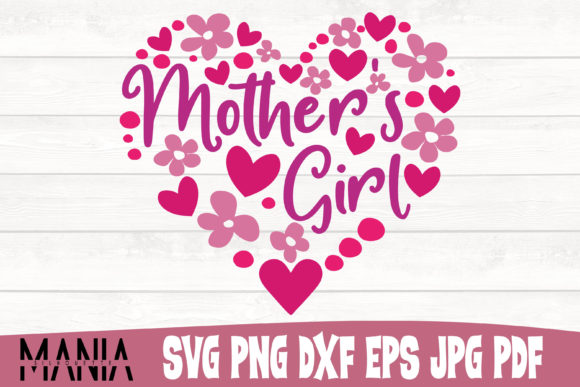
The Mother’s Girl Heart Design Cut File represents a specific category of digital assets tailored for the personalized apparel and crafting market. For professionals and serious hobbyists managing print-on-demand businesses or custom design services, the utility of such a file extends beyond its aesthetic appeal. It serves as a functional component in a production workflow where reliability, format compatibility, and layer integrity are paramount. This asset pack is structured to address common friction points in digital fabrication, providing a comprehensive suite of file types that support everything from vinyl cutting to professional graphic editing.
Technical Specifications and Format Utility
A primary consideration when acquiring digital design assets is the breadth of included formats. The Mother’s Girl Heart Design Cut File distinguishes itself by offering six distinct file variations, each serving a specific technical purpose within the creative ecosystem. Understanding these distinctions is essential for maximizing the asset's value across different platforms.
- SVG Files: The pack includes one SVG file optimized for Cricut Design Space and Silhouette Studio. This vector format is the industry standard for cutting machines because it retains mathematical path data, allowing for precise blade guidance without pixelation.
- PNG Files: A high-resolution PNG with a transparent background is provided for sublimation printing, direct-to-garment (DTG) applications, and digital mockups. Transparency ensures the design integrates seamlessly onto colored substrates without unwanted white boxes.
- EPS Files: For users requiring deep customization, the EPS file facilitates editing in vector software like Adobe Illustrator. This format preserves node structures, enabling designers to alter typography, adjust curves, or combine elements with other assets.
- JPEG Files: Specifically noted for Iron-On Machines, this raster format supports heat transfer workflows where vector paths are unnecessary, and color fidelity is the priority.
- DXF Files: This format ensures compatibility with older versions of Silhouette Studio and various CAD-based cutting systems, broadening the hardware accessibility of the design.
- PDF Files: Serving as a master reference, the PDF contains all clip art in a single document, useful for client approval proofs, cataloging, or archival purposes.
This multi-format approach eliminates the need for third-party conversion tools, which often introduce artifacts or degrade line quality. By providing native files for both consumer-grade cutters and professional design suites, the asset supports a hybrid workflow common among modern creators who may prototype on a Cricut but finalize production files in Adobe Illustrator.
Layer Integrity and Production Reliability
In digital fabrication, file structure is as critical as visual design. Poorly organized cut files result in wasted material, machine errors, and excessive weeding time. The Mother’s Girl Heart Design Cut File is described as having meticulously crafted layers that are continuously tested. From a practical standpoint, this suggests that nodes are welded correctly, overlapping paths are minimized, and color separations are logical.
For users operating vinyl cutters, well-defined layers translate directly to efficiency. When a design is properly layered, the machine cuts each color separately in an optimized sequence, reducing head travel time and registration errors. For those using the EPS file in vector editing software, organized layers mean that elements can be isolated, recolored, or resized without breaking the overall composition. This level of structural discipline reduces the pre-production cleanup time that often plagues downloaded graphics, making the asset viable for commercial environments where turnaround speed impacts profitability.
Scalability and Application Versatility
The vector-based nature of the core files (SVG, EPS, DXF) provides infinite expandability without quality loss. This characteristic is fundamental for businesses that offer products across multiple size ranges. The same source file used for a toddler’s onesie can be scaled up for an adult XL t-shirt or adapted for large-format signage without requiring redrawing or upscaling algorithms that compromise edge sharpness.
While marketing descriptions may hyperbolically suggest printing "on the moon," the practical implication is genuine resolution independence. Whether the output is a 2-inch sticker or a 24-inch window decal, the mathematical precision of the vectors remains constant. This flexibility allows entrepreneurs to diversify their product lines using a single licensed asset. The design can be applied to:
- Apparel via HTV, sublimation, or screen printing.
- Paper goods including greeting cards and scrapbooking.
- Hard surfaces through adhesive vinyl or laser engraving.
- Digital products such as printable wall art or social media templates.
The inclusion of raster formats (PNG, JPEG) alongside vectors further enhances versatility, ensuring that users without vector editing capabilities can still utilize the design for print applications, albeit with fixed resolution constraints.
Software Ecosystem Compatibility
Interoperability is a significant factor in asset selection. The Mother’s Girl Heart Design Cut File demonstrates broad compatibility across the current landscape of creative software. Support for Cricut Explore and Silhouette Studio covers the majority of the DIY and small business market. However, the explicit mention of Make The Cut and Sure Cuts A Lot indicates attention to legacy users and those utilizing alternative cutter ecosystems.
On the professional side, compatibility with Adobe Illustrator, Photoshop, Flash, and After Effects suggests the files adhere to standard encoding protocols. While Flash is largely obsolete for web content, its inclusion hints at backward compatibility that may benefit users working with older animation pipelines or specific proprietary RIP software. Furthermore, compatibility with 3D editing software opens niche applications, such as applying the heart design as a texture map or decal on 3D-printed models. This wide-ranging support makes the pack a safe investment for studios with diverse toolchains, reducing the risk of purchasing assets that require expensive middleware to function.
Target Audience and Practical Use Cases
This asset pack is best suited for specific user profiles rather than general consumers. Small business owners in the personalized gift sector will find immediate value in the ready-to-cut formats, which streamline order fulfillment. Freelance designers can utilize the EPS and SVG files as base components for larger custom projects, saving billable hours on illustration. Educators and workshop leaders may appreciate the PDF and PNG formats for creating instructional materials or class kits where students do not have access to cutting machines.
However, users should assess their specific needs against the asset's characteristics. If a creator requires fully editable text elements within the SVG, they must verify whether the typography has been outlined or remains live, as this varies by designer. Similarly, while the JPEG is suitable for iron-on transfers, professionals seeking photorealistic DTG results should prioritize the high-DPI PNG. The asset excels in scenarios demanding quick deployment and cross-platform consistency but assumes the user possesses the requisite hardware and software knowledge to leverage the provided formats effectively.
Assessing Long-Term Value and Workflow Integration
When evaluating the Mother’s Girl Heart Design Cut File, consider it as a modular component of a broader design library. Its value lies not just in the immediate project but in its reusability and adaptability. The organized layer structure and multi-format delivery reduce future troubleshooting, effectively lowering the total cost of ownership compared to free alternatives that often require significant remediation.
For sustainable integration into a creative workflow, users should establish a consistent naming and storage convention upon acquisition. Because the pack includes six files, maintaining version control prevents confusion between the cutting SVG and the printing PNG. Additionally, testing the EPS file in your primary vector editor before committing to large production runs ensures that font substitutions or stroke expansions behave as expected. By treating this asset with professional asset management practices, creators can maximize its utility across seasons and product iterations, ensuring it remains a reliable resource in their digital toolkit.